Technical Resource
Adhesive Pump
Plant transfer of adhesives and sealants. Drum to tote, tote into process, tank to tank, load-out.
This page is for plant transfer of adhesives and sealants. Drum to tote, tote into process, tank to tank, load-out. NAPCO builds the 2-inch and 3-inch rotary gear pumps for that job. See adhesives and sealants for the industry page.
NAPCO does not make spray guns, hot-melt applicators, or metering robots.
What adhesive pump means here
The fluid is thick. It has to move as a measured volume, not as a thin stream thrown by a centrifugal impeller.
Gears mesh and carry a fixed volume each turn. Shaft speed sets flow. System backpressure sets the load, up to 100 PSI. Details: rotary gear pump working principle.
NAPCO pumps prime themselves. Reverse the motor and the same line unloads. That matters when you clear a hose of adhesive instead of flushing solvent through a second pump.
This is surface transfer. Not a high-pressure dispense head.
The longer viscosity-selection writeups live at high-viscosity adhesive pump guide and pump selection for adhesives. Use those when you are still choosing a pump type. Use this page when you already want a NAPCO gear pump for adhesive transfer.
Why a gear pump
Adhesives and sealants are usually too viscous for a centrifugal to fill. A gear pump does not rely on velocity. It meters.
Performance tables on the product pages are water at rated speed. The pages also say higher-viscosity fluids may require lower RPM. Size from measured viscosity at pumping temperature, plus the flow and pressure you need. Sizing: how to size a rotary gear pump.
Do not guess a viscosity number we have not measured on your formula.
Which model
Live product copy puts adhesives on the C models when the fluid does not attack iron. That is PA300C and PA200C. Spec stainless S models when the solvent package or the adhesive itself is corrosive. Comparison: stainless steel vs ductile iron pumps.
If you do not have an SDS, ask before you order the housing.
PA300C
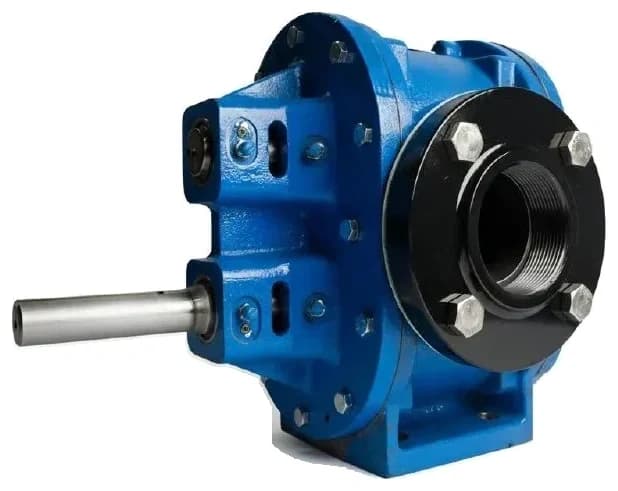
The PA300C is the 3-inch pump. 158 GPM at 280 RPM and 10 PSI. 140 GPM at 100 PSI. 13.4 bhp at 100 PSI. Max 100 PSI, max 280 RPM, 173 lbs. 3-inch NPT.
Plant pump-over, tanker load and unload, high-volume transfer.
The live page names petroleum, adhesives, coatings, and industrial fluids.
PA200C
The PA200C is the 2-inch pump. 69 GPM at 190 RPM and 10 PSI. 60 GPM at 100 PSI. 5.7 bhp at 100 PSI. Max 100 PSI, max 190 RPM, 114 lbs. 2-inch NPT.
Tote and drum work, smaller batch lines.
The live page names petroleum, adhesives, sealants, and industrial fluids.
Both sizes prime themselves and run either direction.
If the formula attacks iron, use PA300S or PA200S. Same hydraulics. Stainless housing. See chemical resistant gear pump when solvent attack is the real problem.
Rebuild
A factory kit is gears, seals, bearings, and gaskets. 2 to 5 hours on the 3-inch (PK300C). 2 to 4 hours on the 2-inch (PK200C). Hand tools. The product pages put kit cost at 30 to 50 percent of a new pump.
Gears
Nitrile gears are standard on these pumps. Viton gears are the option when the adhesive solvent package is aggressive.
Viton seals are already on every NAPCO pump. The gear is the part you change with the solvent.
Send the SDS before you assume either elastomer is safe. Ketones especially. Do not guess.
Jobs this pump should not take
This is surface transfer, not a spray loop and not a high-pressure injection skid. NAPCO’s tested ceiling is 100 PSI.
Hot-melt units and spray applicators are a different machine. We do not build those.
If the adhesive cures in the pump, you have a process problem. Slow the RPM and do not leave product sitting in the case.
FAQ
What is an adhesive pump?
A pump specified to move adhesives and sealants without thinning them down to water. For NAPCO that is a 2-inch or 3-inch rotary gear pump, usually PA200C or PA300C, sized on viscosity, flow, and pressure.
Can a gear pump handle thick adhesive?
Yes, as a positive-displacement pump. Flow follows speed. Thick product still needs a lower RPM than the water table. The product pages say that in plain language.
PA200 or PA300?
2-inch (PA200C) for drums, totes, and smaller lines. 3-inch (PA300C) for plant pump-over and load-out. Same 100 PSI ceiling on both.
Do I need stainless?
Only if the formula attacks iron. The C models are the adhesive spec on the live product pages when the fluid is non-corrosive. Send the SDS if you are not sure.
Nitrile or Viton gears?
Nitrile is standard. Viton is the option for aggressive solvents. Send the SDS. Do not assume.
Can I rebuild it?
Yes. PK300C, 2 to 5 hours. PK200C, 2 to 4 hours. Hand tools. Kit is 30 to 50 percent of a new pump, per the product pages.
Specifying an adhesive pump
Send SDS if you have it, viscosity at pumping temperature, flow, and pressure. We will confirm housing, gears, and size.