Technical Resource
Pumping Ammonium Nitrate Emulsion & ANFO: Pump Selection Guide
Which Ammonium Nitrate Products Can Be Pumped?
Operators searching for an ammonium nitrate pump are usually handling one of four different products, and only three of them are pumpable. Getting this distinction right is the first step in specifying equipment for an explosives manufacturing or blasting operation.
| Product | Pumpable? | Handling Method |
|---|---|---|
| Emulsion explosive (matrix)Viscous water-in-oil emulsion | Yes | Stainless steel gear pump (surface transfer) |
| AN solutionHot concentrated liquid | Yes | Stainless steel pump, temperature-rated elastomers |
| Heavy ANFO (high emulsion blend)Emulsion/prill blend | Blend-dependent | Pumpable at high emulsion ratios; augered otherwise |
| Straight ANFODry prills + fuel oil | No | Augered or pneumatically loaded, not pumped |
Straight ANFO, ammonium nitrate prills mixed with roughly 6% fuel oil, is a dry, granular blasting agent. It flows like grain, not like a liquid, and is loaded into blast holes with augers or compressed air. The pumps in an ANFO operation move the ingredients: fuel oil on one side, and increasingly, emulsion matrix in heavy ANFO blends. If your operation is pure ANFO, your pumping need is the fuel oil transfer system. If it includes emulsion in any form, keep reading.
Why Ammonium Nitrate Requires Stainless Steel
Ammonium nitrate solutions and emulsions are corrosive to ductile iron and carbon steel. In pump service this shows up three ways: corrosion products contaminate the emulsion, pitted internal surfaces accelerate gear and seal wear, and housing corrosion progressively shortens equipment life. In explosives manufacturing (where product purity and predictable equipment behavior are safety issues, not just maintenance issues), iron in ammonium nitrate service is a false economy.
This is why stainless steel is the global standard for ammonium nitrate pumping. NAPCO’s PA300S and PA200S use stainless housings and shafts with Viton seals as standard. Ductile iron models (PA300C, PA200C) remain the right choice for the non-corrosive support fluids on a mine site (fuel oil, diesel, lubricants) but should never be used in direct ammonium nitrate contact. See the full stainless steel vs. ductile iron comparison for material selection details.
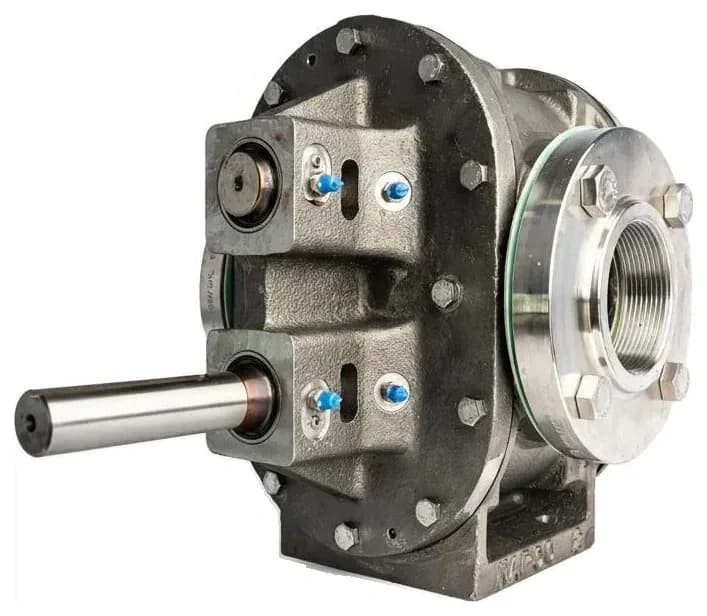
NAPCO stainless steel rotary gear pump: the standard construction for ammonium nitrate emulsion service.
Pumping Emulsion Matrix: Low Shear Is Everything
Emulsion explosives are water-in-oil suspensions of concentrated ammonium nitrate solution in a fuel phase. The emulsion is deliberately engineered to be stable, but shear and turbulence work against it. Excessive shear can break the emulsifier system, separate the phases, and change the product’s sensitization behavior.
Positive displacement gear pumps move emulsion in discrete, gently carried volumes between gear teeth: low shear, minimal turbulence, and no high-speed impeller. That is why rotary gear pumps are the established technology for emulsion surface transfer: bulk plant pump-overs, delivery truck loading, and matrix transfer between process vessels. For high-pressure downhole loading (500+ PSI down a blast hole), progressive cavity pumps take over: see our gear pump vs. progressive cavity comparison for where each technology fits.
Emulsion viscosity swings widely with temperature, from a few hundred centipoise heated to over 1,000 cP in cold weather. Because a gear pump’s displacement is fixed by geometry, delivered flow stays predictable across that entire range. Self-priming and bi-directional operation round out the fit: draw from totes and tanks without external priming, and reverse rotation for line clearing and unloading without re-plumbing.
NAPCO Pump Selection for Ammonium Nitrate Service
PA300S: Bulk Plants & Truck Loading
The 3-inch stainless steel PA300S delivers 158 GPM at 280 RPM (10 PSI) and maintains 140 GPM at 100 PSI: the workhorse for bulk emulsion plants, delivery truck loading, and high-throughput matrix transfer. Maximum tested operating pressure is 100 PSI.
PA200S: Batch Operations & Skid Systems
The 2-inch stainless steel PA200S delivers 69 GPM at 190 RPM: sized for smaller batch operations and skid-mounted transfer systems where portability matters. Use the pump sizing guide or the sizing calculator to match flow rate and pressure to your system.
Elastomers: Nitrile Standard, Viton Optional
Ammonium nitrate emulsions are water-based and non-aromatic, so standard nitrile rubber gears (rated to 240°F) are the normal specification. For hot AN solution service or processes involving other chemicals, Viton gears are available: see the nitrile vs. Viton selection guide. Viton seals are standard on every NAPCO pump.
Field Serviceability at Remote Sites
Mine sites and bulk plants operate far from service centers. Every NAPCO pump rebuilds in the field in 2–5 hours with a factory-matched gear pump service kit (PK300S / PK200S for stainless models): gears, bearings, high- and low-pressure seals, gaskets, and 4 × PB43 cover bolt o-rings, no factory return required. Operations typically stock one kit per pump on site.
System Design Notes for AN Emulsion Transfer
- Relief valve is mandatory: Gear pumps are positive displacement: install a relief valve or bypass set 10–20% above maximum operating pressure. Never dead-head the pump against a closed valve.
- Stainless wetted path: Use stainless piping, fittings, and valves in the ammonium nitrate circuit, not just the pump.
- Inlet strainer: 150-micron strainer on the suction side protects gears from tank scale and debris.
- Temperature management: In cold climates, heated tanks (40–50°C) bring emulsion into the easily pumpable 200–400 cP range and reduce motor load.
- Line sizing: Keep discharge velocity under ~8 ft/sec: a 2-inch line is typical for PA300-class flow rates.
- Washdown and flushing: Bi-directional operation lets you push residual emulsion back to the tank before water flushing at shift end.
FAQ
What pump is used for ammonium nitrate?
Stainless steel positive displacement pumps are the standard for ammonium nitrate emulsions and solutions. Ammonium nitrate is corrosive to ductile iron and carbon steel, so stainless steel construction is required for wetted components. Rotary gear pumps like the NAPCO PA300S (158 GPM) and PA200S (69 GPM) handle AN emulsion surface transfer; progressive cavity pumps are used for high-pressure downhole loading.
Can ANFO be pumped?
No: straight ANFO (ammonium nitrate prills mixed with fuel oil) is a dry, granular blasting agent that is augered or pneumatically blown into blast holes, not pumped. The pumpable ammonium nitrate products are emulsion explosives (matrix), ammonium nitrate solution used in emulsion manufacturing, and heavy ANFO blends with high emulsion content. Pumps in an ANFO operation typically handle the fuel oil and the emulsion phase.
Why does ammonium nitrate require stainless steel pumps?
Ammonium nitrate solutions and emulsions are corrosive to ductile iron and carbon steel. Corrosion contaminates the product, degrades pump internals, and creates safety concerns in explosives service where product purity matters. Stainless steel resists ammonium nitrate attack and is the accepted housing and shaft material for AN emulsion transfer pumps worldwide.
What flow rates are needed for emulsion matrix transfer?
Bulk plant transfer and delivery truck loading typically run 30-160 GPM depending on the operation. The NAPCO PA300S delivers 158 GPM at 280 RPM (140 GPM at 100 PSI) for bulk plants and truck loading. The PA200S delivers 69 GPM at 190 RPM for smaller batch operations and skid-mounted systems.
What gear material should be used for ammonium nitrate emulsion?
Nitrile rubber gears are standard for ammonium nitrate emulsions: the emulsion is water-based and non-aromatic, well within nitrile’s chemical compatibility, and nitrile is rated to 240°F. Viton gears are an option for higher temperature service or when other chemicals are present in the process. Viton seals are standard on all NAPCO pumps.
Related Technical Resources
- Gear Pumps for Emulsion Explosives & Mining
- Rotary Gear Pumps in Explosives Manufacturing & Mining Operations
- Pump Selection for Emulsion Explosives
- Bulk Emulsion Products
- PA300S: 3″ Stainless Steel Gear Pump
- PA200S: 2″ Stainless Steel Gear Pump
- Stainless Steel vs. Ductile Iron Pump Selection
- Engineering & Performance Data
Specifying a Pump for Ammonium Nitrate Service?
NAPCO has supplied stainless steel gear pumps to explosives manufacturers and mining operations worldwide for over 30 years. Send us your fluid (emulsion, AN solution, or blend), flow rate, pressure, and temperature: we’ll confirm compatibility and recommend the right pump and kit package.